
Root Canal
Painless Root Canal Treatment: Myths vs Facts
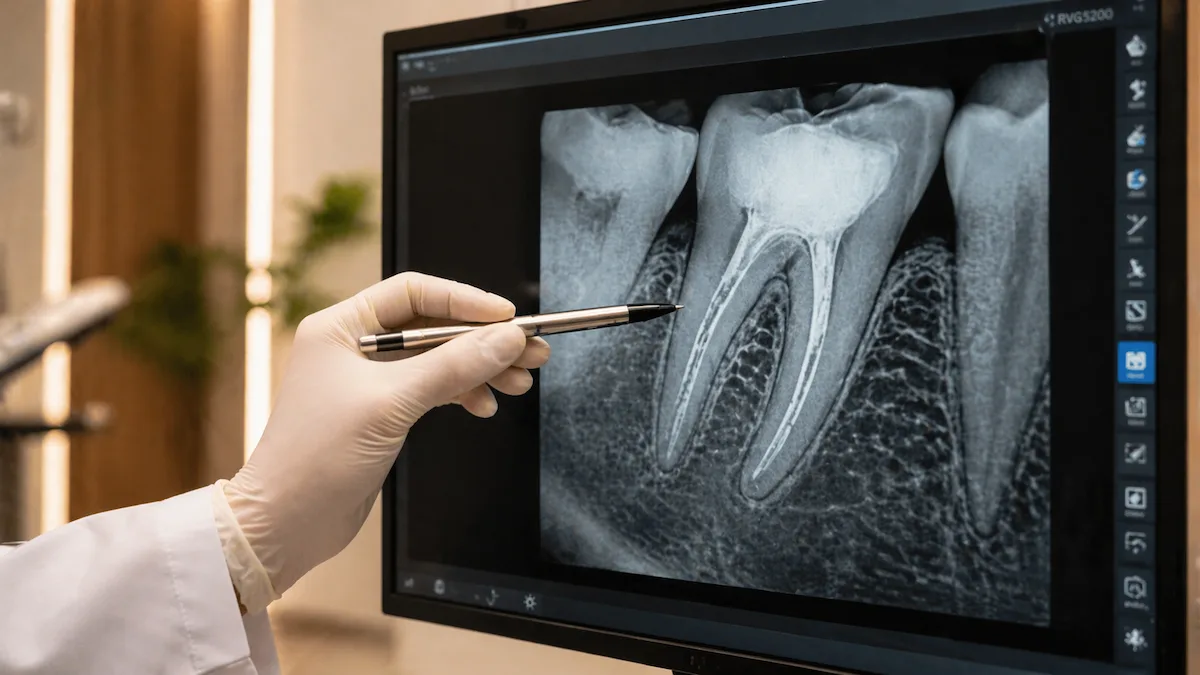
When I tell a patient they need a root canal, I can usually see their shoulders rise. The phrase has a reputation — built largely in the 1970s and 80s — that modern dentistry has long since outgrown. Today, a well-performed root canal is genuinely comfortable, usually completed in a single visit, and is the best way to save a tooth that would otherwise need extraction.
Let me take the most common fears one by one.
Myth 1: “Root canals are extremely painful”
Fact: The pain that sends patients to a dentist in the first place is from the infected pulp inside the tooth. Root canal treatment removes that infected pulp, which is what relieves the pain. The procedure itself is done under local anaesthesia and should feel no worse than getting a filling.
If a patient is feeling genuine pain during an RCT, it usually means the anaesthesia didn’t reach its full effect — often because the infection has lowered the tooth’s pH and the anaesthetic is less effective. A good dentist will recognise this, pause, administer supplementary anaesthesia, and only continue once you’re completely numb.
Myth 2: “It takes 3–4 visits to complete”
Fact: Most root canals today are completed in a single 60–90 minute visit. Multiple visits are only needed for specific cases — severely infected teeth that benefit from intermediate medication, teeth with complex canal anatomy, or teeth in patients with systemic conditions that affect healing.
At our Roorkee clinic, we perform most anterior (front tooth) and premolar RCTs in a single sitting. Molars with complex canals occasionally require two visits. We’ll always tell you which category your case falls into at the diagnosis stage.
Myth 3: “A root-canalled tooth becomes weak and will fall out”
Fact: A tooth that has had a root canal is different from a vital tooth — it has lost its internal moisture supply and can become more brittle over time. This is exactly why a dental crown is almost always recommended after an RCT (especially on molars). The crown protects the tooth from the biting forces it now has to withstand without its internal pulp tissue.
A properly root-canalled and crowned tooth can last 20+ years. What “fails” is usually the crown-tooth interface or a secondary cavity — not the root canal itself.
Myth 4: “RCT has a low success rate”
Fact: Modern root canal treatment has a 90–95% success rate when performed with proper diagnosis, complete canal disinfection, and adequate restoration (typically a crown) afterwards. The earlier you treat an infected tooth, the better the outcome. The biggest reason for RCT failure isn’t the procedure — it’s delayed treatment that allowed the infection to compromise the bone structure around the root.
Myth 5: “It’s better to just extract the tooth”
Fact: Extraction should be a last resort for a restorable tooth. Every time you lose a natural tooth, the adjacent teeth begin drifting, the opposing tooth can start to over-erupt, and the jawbone in that spot starts to shrink. Replacing an extracted tooth with an implant or bridge costs significantly more than an RCT + crown — and nothing is as good as your own natural tooth.
The exceptions are teeth that are fractured below the gum line, teeth with severe bone loss that makes restoration impossible, and some cases where the patient’s medical condition makes root canal treatment impractical.
What a modern RCT at Dantam Dental looks like
- Diagnosis (15 min): Digital X-ray to confirm the infection and assess canal anatomy.
- Anaesthesia (5 min): We numb the area completely. We wait until you’re fully numb before starting — always.
- Access and cleaning (30–45 min): A small opening is made; rotary endodontic files clean the canals. We use sodium hypochlorite for disinfection and rubber dam isolation to keep the working area sterile.
- Obturation (10–15 min): The cleaned canals are filled with a biocompatible material called gutta-percha.
- Temporary sealing (5 min): The tooth is sealed with a temporary filling.
- Crown appointment (2 weeks later): The tooth is prepared for and fitted with a crown.
Most patients are genuinely surprised by how straightforward the experience is. Several have told me they expected to dread the whole thing and ended up checking Instagram through most of it.
How much does root canal treatment cost in Roorkee?
Prices vary by tooth type and complexity. At our clinic, a single-sitting RCT typically ranges from ₹4,000 to ₹8,000. An additional crown, which we strongly recommend especially for back teeth, typically ranges from ₹4,000 (PFM) to ₹12,000+ (zirconia / e.max).
When to come in
If you have throbbing tooth pain, sensitivity to hot/cold that lingers for more than a few seconds after the stimulus is removed, a swollen gum around a tooth, or pain when chewing on a specific tooth — please don’t wait. Infections that can be treated with a straightforward RCT this week can become surgical extractions in three months.
Book a consultation for root canal treatment in Roorkee, or call us at +91 97591 17777 for urgent appointments.